

by 'Rising Falcon'

|
|
Horse racing is full of dramatic contrasts - triumphs and disasters, rare sudden financial gains and equally swift losses. As a lifelong rambler, I would relax before racing by travelling by train to a nearby station and then walking to the course. I have walked uphill to the course from Lewes onto the South Downs Way, passing a prison and the stables where 1966 Derby winner Charlottown was trained. You can clearly still walk along the defunct Lewes racecourse - with the English Channel, brilliant in the distance under rain and sun, and with the ghost of Sir Gordon Richards haunting your every step. After many miles, a steep muddy footpath leads down to Plumpton Village, and then it's only a quiet stroll to the charming, but tricky jumping course - so hated by the great Fred Winter. Also in Sussex, I have alighted at Arundel Station, ambled around the immaculate greensward of the castle grounds, where the loveable, lamented Bernard, Duke of Norfolk, lived with his immensely shrewd Duchess, Lavinia. Their castle stables within the grounds produced many winners in their sky blue colours, mostly notably Ascot Gold Cup winner, Ragstone. Now the stables, originally private, have been enlarged into a major public stable by the immensely successful John Dunlop. In an interview on the eve of his tour of Australia as MCC Manager, the late Duke was asked how he funded his racing operation - "One sold Littehampton..." (a Sussex town) he replied. Bernard sired five daughters, but no male heir, so the title passed to his cousin, Miles. At least Bernard's daughter, Lady Herries (of Celtic Swing fame) trains nearby at Angmering Park and is married to former English cricket captain Colin (now Lord) Cowdrey. From Arundel, I have walked along quiet Sussex lanes to popular Fontwell Park One of my favourite trips is to travel to busy Salisbury station. Outside, hordes of tourists queue for the buses to ancient Stonehenge, where they would innocently pass on their journey a riding school which at the beginning of the century was known as Druids Lodge, where the Confederacy - a group of shrewd owners -plotted immense gambling coups, which would not be entertained today by the public companies which own bookmaking companies.
Racing at Salisbury on weekdays has all the advantages. Crowds are large enough to generate atmosphere, but not overlarge to cause discomfort.
Before each race, both the pre-parade ring and parade ring are easily located next to the Members' Stand (the Bibury Club), and provide clear views of each horse as punters scrutinise the form. Race goers are searching for a future star in the Two Year Old races. Two of the greatest post-war horses ran here at two. Mill Reef won first time out, beating 2/9 favourite, Fireside Chat , easily, starting at odds of 8/1 - with hindsight one of the most generous SPs in history. His great rival, Brigadier Gerard was favourite when he landed the Champagne Stakes, having previously won at his Newbury debut at 100/7. Salisbury provides good class competitive racing with winners hard to find. Former Sussex based trainer, Guy Harwood, greatly favoured this course when he was flying high in the 1980s because it is such a fair test for a thoroughbred, with springy downland turf. Today, local Whitsbury trainer, David Elsworth, along with Royal trainer Ian Balding, mount regular raids but the larger Newmarket yards of Gosden, Cumani and Loder ensure strong competition. The great American jockey, Steve Cauthen, had his British debut here on a wet, muddy Saturday, in front of a massive crowd. He rode a winner, Marqui Universal, and this master of waiting in front rode many more winners here, where, with Major Hern's words "the clock in his head" he was especially effective. At Salisbury I had my luckiest ever winner. It was a five furlong spring handicap with a large field. I had £20 - on the Totaliser - on Number 6, then strolled down the course to watch the race, without checking my ticket. Needless to say, Number 6 was well beaten and the race was won by Number 16 in a photo. Before discarding my ticket, I noticed that I had been given £20 on Number 16 in error, so I sheepishly collected £234. On a warm, sunny, summer's day, racing at Salisbury is such a pleasure that you don't mind backing losers! High on the downs, away from the city, the race course has a wonderful feeling of rural remoteness. My happiest memory is of a summer's day over 25 years ago, when I was a lowly, impoverished settler, based at Tote Credit's then HQ at Ludgate Circus in the heart of London. By the last race, I had built up my original £35 bank into £80. In those days I followed Major Hern's stable at West Ilsley with stylish Joe Mercer as retained jockey. Their filly in the last was thriving in the paddock, moved to post freely on the firm ground. She was 9/4 second favourite in 1 mile maiden fillies race. So forgetting prospects of fish and chips back in Salisbury for supper, I plunged the entire £80 on her - £180 - £80. I watched the race from the top of the grandstand. Four furlongs out she was travelling well, but so were others. Two furlongs out Mercer was slightly boxed in, looking for a gap. He switched to his left and found a clear run. One furlong out he was still third, but closing on the leaders, Mercer rhythmically driving her to the line. They struck the front 100 yards from the line and drew away for a comfortable 10 lengths success. If only fate was always that kind. I walked back to Salisbury a different way, past ancient Wilton House, and celebrated at last with double plaice and chips. |
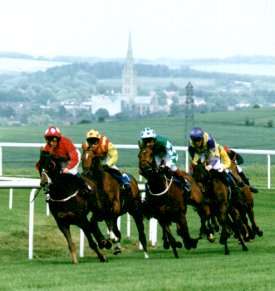 The walk from the station to the racecourse is only 3 miles, so there is time to visit the Cathedral (with England's tallest and most inspiring steeple) and relax on the surrounding Cireen, before crossing a footbridge over the River Nadder and taking the footpath to Hamham Mill. From the path you are close to the exact spot where John Constable painted the Cathedral - with the meadows protected from greedy builders, this rural scene is little changed from Constable's day. The footpath ends at the Old Mill , another scene of a Constable painting. Eventually you cross the main road, and climb the old Roman Road beside the golf course to reach the course at around the three furlong marker, close to the loop.
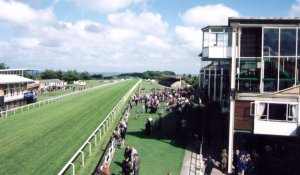 From the top of the ancient Tattersalls grandstand, there are excellent views of the course - with the Cathedral in the distance. For shorter distances, the course is a straight, slightly uphill climb, but for races over 1½ miles and 1 mile 6 furlong, both starts are in the straight close to the stands, so the horses, racing away from you, take the right hand loop, before re-entering the straight with 7 furlongs to run.
