

Horse riding in India
Horse riding in India
by John Ruler

 |
|
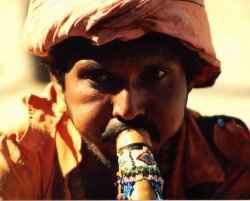
Face of India: street seller in Rajasthan village
|
It's easy to fall for India. Where else but in Rajasthan can you ride through tilled fields in which sari clad women - and the occasional man - flit like so many butterflies in a vivid display of blue, yellow, red and orange amid the dusty yellow of this grey green state? Add the excited cries of the village children as they greet you - the boys full of waves and shouts , the girls far more bashful - the sight of workers gathering water from the well or sheltering beneath the communal People Tree and you quickly fall under its spell.
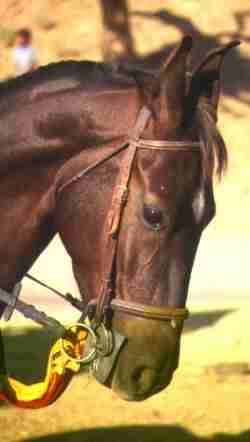
Working the most magic, however, are the Merlins of the equine world - the marvellous Marwari horses whose distinctive inwardly curving ears when seen from the saddle appear as though looking through the sights of a rifle.
 |
|
Head of a typical Marwari horse
|
Ranging in size from 15.2 to 16.2hh, and with longish backs - hence a tendency to stride out on the trot - these delightful creatures are full of the stamina needed for around six hours daily in the saddle. This includes a happy blend of walking , trotting and longish canters which tend to end with a stop beneath a shady tree for long gulps of mineral water supplied from the back-up jeep.
It took a day or two to match rider with horse. This was hardly helped by them being fresh and eager to go - the horses, I mean, not the riders, 11 in all, who, in turn, were initially shell shocked from the culture change. The horse owning Americans, found, as I once did, that it can be difficult to adapt, while the French - one of which began riding when he was 66 (he's now in his late seventies) and another aged 80 - barely flinched. Us four Brits, swapped around a bit - with me losing Laxmi (Goddess of Wealth) , a grey with a Rolls Royce response to the aids, to my sister, back riding after 20 years or so, who found her horse hard going at first.
The ride began with a six hour coach drive from the choking fumes of New Delhi to Dundlod, your mind initially muddled by jet lag and cultural quirks. It is then blown entirely by the red carpet ceremony at the fortress, built around 1750 and now an hotel, in whose yellow brick courtyard garlands of fresh marigolds are strung round your neck. Either side turbaned riders, clad in robes of saffron and red, provide a guard of honour , complete with lances and fluttering flags.
Sleep was fitful, hardly helped by the tabletop nature of the bed on which you lie corpselike, hardly daring to turn less you fall a few feet onto the floor. Fading family photos decorate the walls of the vast room in which an air-conditioning unit has all the appearance of wartime fighter engine - and sounds like it too. Not then a place for those who are lost without a hot shower and loo covers, but still providing basic needs for those prepared to experience a less sanitised look at Indian life. Which is just what you get when exploring the countryside from the back of a horse.
 |
|
Welcome face of India: young wife in Rajasthan village
|
And explore we did, the first three hour ride providing the initial glimpse of the traditional way of life which we were to become accustomed to over the next five days. Who were the most intrigued, us or the villagers, is hard to say. We were, to say the very least a bizarre sight, sporting a variety of head gear and a hot-potch of Western boots, chaps and jodhpurs.
We were lead by the boss man Raghuvendra Singh, simply known as Bonnie, who with his partners run this unique equestrian experience. A fine looking man, sporting a moustache appropriate to his military bearing, and riding a powerful stallion, he proved a genial host with an infectious giggle while still maintaining strict discipline over us riders. The rear was brought up by two grooms, suitably dressed in orange robes, and carrying lances - the overall impression being, as one rider sardonically observed, of the circus coming to town reinforced by the wailing siren of the back-up jeep.
This element of escapism runs strongly through the ride, if no more than simply shedding the suburban shackles to canter along dusty tracks, stopping only for a passing camel or a wagon piled high with cattle fodder, certain in the knowledge that the sound and fury of the nineties could be a million miles away. Save, that is, from the towns with their heaving mass of humanity and gaudily decorated lorries through which stroll grey humped back sacred cows, nonchalantly noshing from market stalls. Swaying camels shrug off the veritable paintbox of sound and colour swirling round them.
Even the cacophony created in Mandawa on our second day in the Shekhavati region, failed to fret the horses as they threaded their way through hooting coaches, goats, cycles, scooters, market stalls, battered, often bonnetless cars, and cows to the comparative peace of the palace hotel with its colonial style rooms and blessedly large bath tubs. I use the term advisedly, for following an al fresco feast and folk dances in the hotel grounds, the night was shattered by the wailing tones of religious fervour broadcast from a temple close by.
 |
|
Bonnie leads a group of riders through a typical
Rajasthan village
|
But then that is India, and all is quickly forgiven with a visit to the havelis, basically spacious residences from Mughal times whose frescoes draw not simply on primitive themes but curiously depict the imperial age with ladies and gents from the white Raj sitting in Victorian splendour in saloon cars or trains. Others underline the role of the horse, in hunting or ceremonial scenes.
Mirror images can still be seen today as the sights and sounds of village life blur into one giant impressionist painting, the colours sharpened each evening when girls, their red saris bright and glittering, stole the limelight at the cabaret style entertainment. This reached its peak when after leaving the almost parkland setting for the comfy Roop Niwas Palace Hotel at Nawalgarh, a gala night was staged later that week at the Samode Palace hotel, made famous as a location shot in The Jewel In the Crown and The Far Pavilions.
 |
|
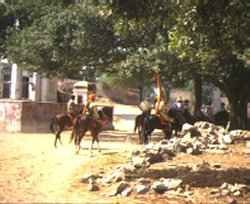
Riders arrive at a Rajasthan village
|
A fireworks display, a guard of honour and a special floor show and Indian fare, served as we sat cross legged on huge intricately decorated cushions, was followed by a tour through corridors with frescoed walls, lit by huge chandeliers , and even a Hall of Mirrors. Tired perhaps from a long day¹s ride, the impression left was of being almost trapped within the scriptures of the legendary Mahabharata, unable to cope with a setting which goes back more than four and a half centuries to the time of the illustrious 17th prince of the house of Kacchawaha Rajputs. Or was it that we were wistfully wishing we were back to the previous night¹s stop at Lohar Gal, a religious shrine clutched in the cool, calm palm of the surrounding Aravalli Hills.
The pilgrims' rest house consisted of small stone cells, a single candle and camp beds which proved some of the most comfy we came across. Canvas latrines were provided at the back. It was pure bliss. Sunayana, our lady mentor and a lynchpin in the back-up team which provided lunches of tantalising soups and freshly cooked Indian fare, picked out tiny shrines in the darkening hills, to which pilgrims come some crawling on hands and knees to pay respects to a variety of gods. We drew closer to the fire, laughed at a rib-tickling show stage by the grooms, clad in saris, and sang communal songs as only a close knit team of riders can. I have experienced it before, but no more so than in the black stillness broken only by the sound of the horses shuffling under the giant banyan tree, their tangled roots clinging like tentacles to this place of peace.
This and the sight of a lone camel, among the thousands bought and sold, silhouetted against a setting sun at the Pushkar Fair, a desert location of almost Biblical quality, will remain the stuff that dreams are made of... As, indeed, is most of Rajasthan, helped by a horse called Laxmi.
 |
|
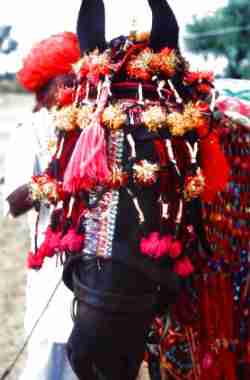
All dressed up: Marwari horse at festival
|
INFORMATION BOX:
Contact: Cox & Kings (Tel:0171 873 5000); Equitour (Tel: 01865 511642); Indian Encounters (Tel:01929 481421); In The Saddle (Tel: 01256 851 665); Ride World Ride (Tel: 0171 735 1144).
The Rajasthan/Pushkar Fair Ride in late autumn can be split into two (of which the author rode the first half) Cost: from around £2,500 to over £3,000 depending on length of ride, plus around £600 for the air fare London to New Delhi which can be arranged. The cost covers virtually everything from accommodation to hire of horses, meals and transfers. You need little in the way of spending money, other than for drinks in the evening or shopping which is tempting. Allow an additional £30 to £40 for mandatory insurance.
Food: Good Indian fare, especially on the rides, with most riders avoiding the dreaded Delhi belly. You are more likely to fall victim in a modern hotel.
Accommodation is basic in many places, a price you pay for rural rides. The horses horses are up to scratch, with a chance to swap around, with cavalry style saddles far more comfortable for long rides than they look.
A list of what to take is supplied at the time of booking. Healthwise consult your doctor or health clinic on current requirements but be prepared to protect yourself against malaria, hepatitis, typhoid, polio and consider a rabies jab as well. A tourist visa is required.
Recommended reading: Rajasthan (Insight Guides) at £12.99 .
|
John Ruler is the author of an excellent book entitled
Great Riding Holidays - A Global Guide to Holidays on Horseback. Read
a review here
|
Click Here
or send an email to
joynext@field-galleries.co.uk
to be notified when the next issue
of the magazine is published
If you wish to get in touch with us about any other matter please use the contact form
