

 |
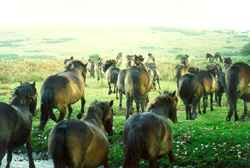
| The healthy mares returning to the moor. |
After the account of the gathering of Herd 23, and subsequently the inspection and branding procedure, you will have realised that October is an important month in the life of an Exmoor pony, and particularly in the life of the long-standing free-living herds. During their short time "inground" decisions are made which can set a pattern for the rest of the ponies lives. Mares are looked at closely - will the older ones cope with another harsh Exmoor Winter? Would it be fair to turn them back out to feed not only themselves, but also their unborn foals? And the stallions - how are they coping? Have they got what it takes to be a hill stallion? And most importantly, are they stamping their stock with what it takes not only to pass inspection, but to live a tough self-sufficient life on the moor? Or maybe to carry a rider through a long day s hunting, or even give a young child the pleasure of his first gymkhana rosette. All of these things must be considered for it is not only the ponies reputations that are at stake, but also those of the hill breeders - the guardians of this hardy, versatile, yet genetically precious pony.
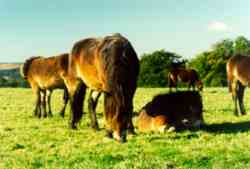 |
| Stallions, mares and foals all mix together after the gathering... Here a foal lies quietly beside a stallion. |
Amongst the enthusiasts, each herd has it s own characteristics, be it colour, size or amount of bone, and it is interesting to see that for many, once a relationship has been struck with a herd, purchasers will go back to the same one each time they wish to add to their numbers. So where do these foals go once they leave the security of their herds? The distribution is worldwide - from Sweden to the Falklands, and their uses manyfold. Obviously their size would suggest an ideal child s pony, but don t be deceived, they are more than capable of carrying an adult for the best part of the day, whether hacking or hunting. Several people have also discovered the pleasures of driving with Exmoors. Taking into account their uniformity, finding a matching pair is no great difficulty! Until the arrival of the tractor they were a part of farm life, not only ridden by the children but quite often the only form of "horse power" - pulling the chain harrows and the carts. There are even reports of one farmer in Withypool using two side by side to plough the land. It is also a well known fact that the Exmoor will carry up to 12 stone comfortably for the best part of the day thus making them an ideal choice as a family pony. The fact that they are also used by some Riding for the Disabled Centres is also a great testament to their temperaments. Sadly, the ponies have limited success in the showring, mainly due to the fact that they should be presented in a "natural" state - no plaiting of the mane or pulling of the tail. This can lead to them being thought of as untidy in appearance by judges when competing in a mixed class.
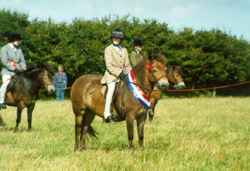 |
| The exmoor makes an ideal child's pony... |
A more recent string to their bow has been the conservation issue. As the country
becomes more ecologically aware, new ways of managing sensitive areas of land are
being sought. The general hardiness of the Exmoor pony and the ease of management
has made them an ideal choice as conservation grazers. Results have been quite
remarkable - improvements in the sward, the re-establishment of interesting flora,
and low maintenance costs mean that the Exmoor pony is not only conserving some of
our most beautiful habitats, but in doing so is also conserving itself!
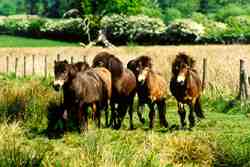 |
| These ponies are being used to graze a 'conservation' are. |
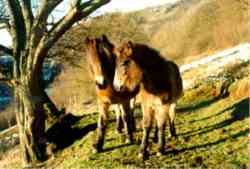 |
| Exmoor ponies are very hardy and ecomnomical to keep. |
Some years ago, thanks in no small way to the success of the "Moorland Mousie" stories, everyone with an interest in equines had heard of the Exmoor pony. Indeed, most had owned one in their lifetime or at the very least knew of someone who had been fortunate enough. Their versatility was their trademark. Surely it is now time for a return to that situation, preferably on a more permanent basis. At present, the Exmoor pony is not "fashionable". Whilst no-one with a genuine interest in their well-being would want them to become a fashion accessory - a mere flash in the pan, surely the time has come for them to be recognised once more for their potential in every aspect of equine pursuits. The colts will make excellent ambassadors to this end. With a helping hand from those with the knowledge and enthusiasm to re-introduce them to an unsuspecting public, one will wonder how they ever managed without them! So let s rally to and begin a new age of modern "Moorland Mousie" stories!
An Introduction to the Moorland Mousie Trust
Feeling that it is time to take some concerted action to restore this very special breed to it s former status as a desirable all round family pony and to help maintain a diverse genetic pool within the breed, a group of us are in the process of establishing a charitable trust with the following aims:-
- To create greater awareness of, and demand for, the Exmoor pony as the ideal family pony
- To provide a future life for male foals born on the Moor as working, riding and driving ponies
- To establish a centre on Exmoor for riding activities and holidays exclusively using Exmoor ponies
- To create greater awareness of their plight worldwide and to encourage sales at home and overseas
This trust is to be known as
"The Moorland Mousie Trust"
and full details will be available in early 1999. If you would like to be kept informed of the Trust s activities or should you be able to offer any assistance, whether by fund raising or, in due course, with preparing ponies to work at the Exmoor centre, we would be delighted to hear from you.
The Trust will be setting up it s own web page on Field Galleries site.

If you wish to be notified when the next issue is published,
please email us at joy@field-galleries.co.uk
or Click Here
If you wish to get in touch about anything else please use our
contact form