

Listening to Bill Clark (Willie to his friends) recount tales of his youth spent growing up on a large estate in rural Hampshire creates wonderful images of an era long gone; quite simply a different way of life...
In England between the wars there still existed the huge estates which had been structured along similar lines for centuries. Handed down through generations, they thrived and supported large work forces to such an extent that they existed as self contained communities in their own right. Virtually all the food consumed by owners and workers alike was produced on the estate and the workers were housed and provided for by their employers.
At Preshaw Park for example, where Willie s parents (and other relations) lived and worked, Willie recalls the annual trip to the seaside for mothers and children; the sports days; the estate s own cinema (where silent movies were viewed in the garage - the chauffeur operated the equipment!): moonlight trips into nearby Winchester every fortnight - an opportunity for male estate workers to let their hair down and the annual gift of 3cwt of coal and a fresh turkey for every family at Christmas...
The estate employed 9 gardeners, four full time gamekeepers and two rabbit catchers, who also helped with rearing the young game birds (Preshaw was renowned for having excellent shoots). The entire household of maids, kitchen staff, butlers, etc., used to move from the country residence to London and to Scotland at different seasons in accordance largely with the social calendar.
Willie s father spent 50 years working at Preshaw and his Grandfather before him... just as the estate s ownership passed from generation to generation, so did the jobs on the farms.
 |
| All competitors lined up for a ploughing match - Willie was helping his uncle in this event. |
Over 40 horses were kept permanently in work at Preshaw; they were used wherever power or transport was required - i.e. for ploughing, haymaking, harvesting, in the mangol carts and for moving timber (the estate had it s own sawmill) and ploughing matches were held between the four farms on the estate which was able to provide as many as 16 teams for the event! A horse was even used for cutting the lawns, wearing special protective leather boots to prevent digging into the treasured turf; for pulling the game carts during the shoots and even for taking water to the sheep...
Growing up in such an environment, Willie was inevitably involved with horses on a daily basis, both as a small boy and into his teens, and as a result he built up a great reservoir of knowledge about their care and handling simply by absorption and experience - the greatest teacher of all.
Willie fondly recalls a Clydesdale called Poppy who he used to ride back to the stables after work was finished... apparently she would simply take off and wouldn t stop until inside her box. This behaviour produced a few hairy moments and Willie had to pray that her stable door had been left open!
 |
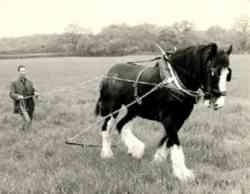
| Mostly Shires and Clydesdales were used - here a well turned out pair at a ploughing match. |
The horses used were mostly Shires and Clydesdales, although these breeds were changed somewhat over the years. The Shires tended to be smaller and more compact since they had more pulling power by being lower to the ground. They were often crossed with Clydesdales to get silky feathering which was much easier to clean after working in the fields all day.
Willie says "Horses were worked by very hard in those days, although at Preshaw they were generally well fed and cared for and given days off... but on smaller farms it was often a different story. There is no doubt that many farm horses were underfed and overworked..." life wasn t all rosy for the work horses then and maybe the advent of the tractor saved many from a life of drudgery.
Willie left Preshaw Park when he was 25... by then he was married to Betty who had also lived and worked on the estate... and they moved to nearby Rotherfield Park where Willie was head tractor driver for 8 years. Willie had no contact with horses at this time since, as on most other farms, the working horses had been sold off after the Second World War... farmers having depended on them for centuries, within the space of but a few years replaced them with tractors. Horses were sold off in their thousands and mostly went for slaughter... poor recompense for generations of service.
Willies insists that it is a miracle that British heavy horse breeds didn t become extinct at this time since there was little or no interest in them in their own right. As so often happens, just a handful of breeders kept them ticking over and in the last 20 years there has been quite a resurgence of their numbers. The Shire for example has been taken off the endangered list - although sadly both the Clydesdale and Suffolk Punch are still on it, and according to Willie there are more horses working on farms now. Once again they are valued in certain situations where they are more environmentally friendly.
 |
| Willie and 'Regent' at Regent's first show. |
After so many horseless years, Willie and Betty rescued a thoroughbred mare who, although well bred, had been injured and could not race. Tender loving care worked wonders and eventually she was sold for breeding. In the meantime, Willie had helped out at a local ploughing match and, his enthusiasm rekindled, he asked a top breeder to look out for a good horse for him - he wasn t fussy about the breed but he did stipulate that it should be black with four white feet! Before long he had acquired Regent, an 18 month old Clydesdale who was to become his pride and joy and much loved by him and Betty. Willie had just got Regent going, working in long reins and pulling a sleeper as part of his early training, when Willie was involved in a serious accident which could have left him crippled. Fortunately he did recover but he was forced to take a 12 month lay-off and it is possible that this was the real cause of problems later in life which have led him to have 3 hip replacements... so far! Although a frustrating time in his life, Willie simply couldn t be totally idle and he spent the time restoring a Norfolk Farm Wagon - an unusual vehicle which was later to contribute to his success in the show ring. When purchased it was in a sad state and Willie completely rubbed it down and painted it - despite having a leg in plaster at the time!

If you wish to be notified when the next issue is published,
please email us at joy@field-galleries.co.uk
or Click Here
If you wish to get in touch about anything else please use our
contact form