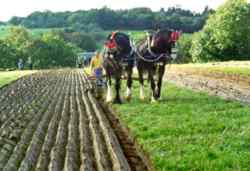
The sharp-angled furrows of the highcut are clearly visable
‘Ins and Outs’ is the descriptive phrase for starting and ending each furrow. It should be a neat operation and
affects the scoring. The practical purpose is to allow clean ploughing of the headland (the area outside the plot,
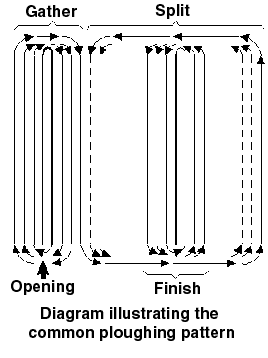
where the horses turn) when the main area is complete. There is a traditional pattern of ploughing to be followed.
The ploughman starts with a ‘gather,’ which includes the ‘opening,’ the ‘crown’ and sometimes a few more ‘rounds.’
For this the ploughman turns his team continually to the right at the end of the furrow. When he has completed his
‘gather,’ he will turn the team to the left and move across towards the next plot for his next furrow. Then he will
continue to turn left around the diminishing area of unploughed land, until he reaches his ‘finish.’
At our match, there are classes for different styles of ploughing. They are ‘High Cut,’ described briefly above,
‘Long Turn-Furrow’ and ‘Short Turn-Furrow’, all of which describe the type of equipment used. The shorter the
turn-furrow, or mouldboard, the greater the tendency for the furrow slice to break up as it is turned. Sometimes
this is what is required and is even assisted by having cutting fins on the mouldboard.
As we said at the beginning, these are only brief notes. The type of plough the ploughmen use and how he sets it depend
on what his purpose is, what operations follow, what the soil is like and what is to be sown there. There are many
other considerations that go to make up the deceptively simple art of ploughing.
Coulter - the blade attached to the plough beam that makes the vertical cut in the soil. Crown - The first three furrows each side of the opening. In some places it represents a larger number of furrows each side. Finish - The last part of the area to be ploughed, consisting of three rounds and the sole furrow. Furrow - The trench left by the removal of the long strip of soil by the plough. Gather Ploughing around the opening or first furrows by continuously turning right at the headlands.
This turns the furrow-slice always towards the opening. High-cut - Ploughing which turns the furrow-slice that stands as high as its width. These close-packed,
sharp-angled furrows best accept seed sown broadcast and weather best through the winter on soil prone to puddling.
A relatively narrow furrow, between 5¾-in. and 7½-in. wide. Also called an ‘oat seed furrow’. Ins and Outs - The points where the plough share enters and leaves the ground at the headland.
They should be well in line with the headland furrow so that the headland ploughing neatly completes the job. Land-side The side towards the unploughed land. The side of the furrow against which the vertical part of the slade
presses. Parts of the plough are differentiated this way too. Long Turn-Furrow - Mouldboard over 43-in. long. Mould-board - The conspicuously curving plate on the plough that turns the cut furrow-slice over.
Also called the breast, wing or turn-furrow. Opening - The first operation in ploughing, consisting of two scratch furrow which support the first full
furrow-slice at the correct angle. Also called a veering. Share - The blade attached to the frame of the plough which makes the horizontal cut in the soil.
Often it is attached to a lever so that the point may be raised or lowered. Also called a sock. Short Turn-Furrow - Mouldboard under 43-in. long. Sole Furrow - The last furrow to be turned in a finish.
If you wish to be notified when the next issue is published,
please email us at joy@field-galleries.co.uk
or Click Here
If you wish to get in touch about anything else please use our
contact form